Contextual Information
American Education and National Identity
For nearly four centuries, the Philippines was colonized by Western countries; Spain conquered the islands from 1565-1898 and the United States conquered from 1899-1946. Under the guise of “benevolent assimilation” ordered by President William McKinley, the United States established American-style government, communication infrastructures (newspapers, telephones, radio), schools, and more during the early 20th century. The public school system was particularly robust; between 1903 and 1940, the number of schools increased from 3,000 to 13,000. These schools enforced English-language instruction and communication as well as American history, traditions, democratic principles in order to paint an idealistic picture of the United States. State-sponsored universities and conservatories were established as well; St. Scholastica's College and the University of the Philippines Conservatory of Music (hereafter UP Conservatory), were established in 1906 and 1916, respectively. Prior to American rule, the musical landscape was largely tied to the Roman Catholic Church. Filipino musicians typically received their training from the clergy, and produced vespers, hymns, and masses to be performed in liturgical services. Formal music schools established by the United States created both a burgeoning secular music scene and a class of highly-trained musicians adept at composing and performing Western music. The UP Conservatory in particular produced Nicanor Abelardo, Francisco Santiago, Lucrecia Kasilag, and Eliseo Pajaro, all of whom led successful careers in the Philippines and abroad. The music schools taught Western music theory and history, training composers to write in genres such as the symphony, concert overtures or symphonic poem. Composing for the orchestra was seen as a respectable endeavor given its technical and lengthy nature.
Views on the American school system were mixed. Some Filipinos feared that English-language schools would create a “homogenous” country with forgotten cultural values. Sociologist Anthony Christian Ocampo described the "benevolent assimilation" behind the new education system as a euphemism for "paternalistic racism," for they did not consider the needs of the Filipino people. Others viewed the school system as positive, for their English-language studies allowed them to work in the government and attend school abroad. The music schools in particular also sought to position Western aesthetic ideals as being technologically superior and more sophisticated. The American government hired foreign professionals to serve as the first teachers at the UP Conservatory with the goal of “rais[ing] the creative skills of the Filipino composers to the same level as composers from the Western world.” This, of course, relies on the problematic assumption that Filipino music was somehow inferior prior to Western intervention. Local news outlets lamented the “lack of music appreciation” in the Philippines compared to the United States and Europe, and cited the absence of a systematic study of music as the cause. Just 23 years after the founding of the UP Conservatory, the first music textbook written by a Filipino author (Antonio J. Molina) was published and distributed to music institutions across the country. Notably, only European and American sources were referenced in the textbook, further cementing the notion of Western art music as the authoritative source for musical ideals.
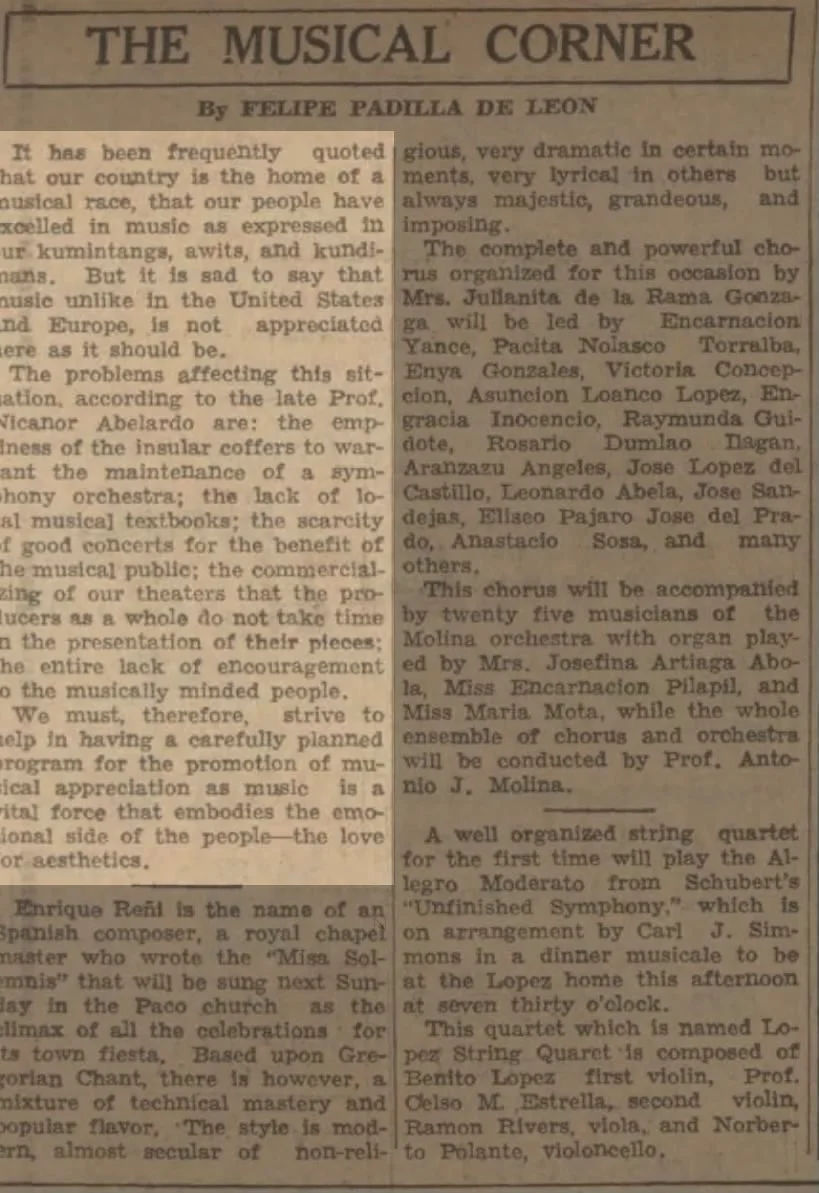
The Tribune, Manila, Philippines, August 20, 1936, newspapers.com
The American government also established the Pensionado Act in 1903, which allowed Filipinos to pursue higher education in the United States, under the condition that they would return to the Philippines immediately after graduation to become civil servants. As more Filipinos were being educated abroad, the desire for a national identity, apart from the Americans, increased. The arts and humanities proved to be a valuable tool for this endeavor. The University of the Philippines formed an “oriental languages” department in 1924 as interest in Filipino regional languages grew. UP Conservatory professor Francisca Reyes traveled throughout the Philippines to record regional folk dances, eventually leading to their popularity in Manila and the establishment of a canon of national dances. When composer and pianist Francisco Santiago performed one of his own works at a solo recital in Chicago in 1924, he stated that his reasons for doing so were that “Filipino above all, I thought I should do my part [for] propaganda for our country. I wanted the American public to perceive that we are not savages.” Later, Santiago became the first Filipino director of the UP Conservatory and encouraged the study of indigenous Filipino music at the institution.
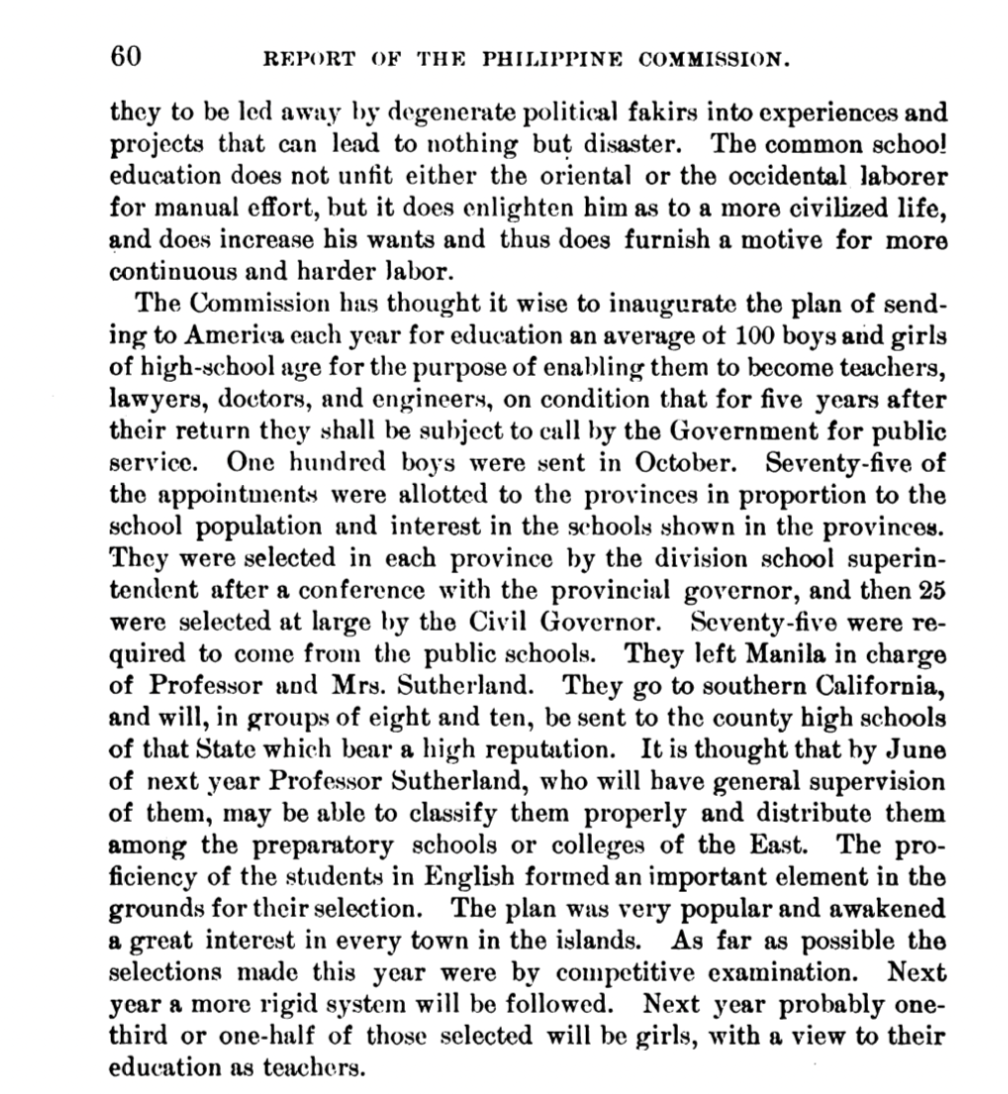
Report of the Philippine Commission to the Secretary of War 1902/1903, part 1. Source: Haithi Trust
The goal, though, was not to abandon Western music training and resort to “just” the study of indigenous music. The nationalist Filipino works that grew out of the American colonial period blended Filipino music into Western classical forms. This was partly to preserve Filipino folk songs, which were seen as becoming lost without their notation. At the same time, Filipino musicians were looking for ways to construct concrete symbols of “Filipino-ness” that would gain respect in the global community. Nicanor Abelardo, a student and later a faculty member at the Conservatory, wrote:
-Nicanor Abelardo
It was also at the UP Conservatory that Pajaro decided he wanted to pursue composition as a career. The encouragement to do so came from none other than Francisco Santiago, who by that time was the conservatory’s director. Santiago’s sentiments clearly made an impression on Pajaro, since most of his compositions from then onwards were based on Filipino folk songs or mythology. Pajaro’s documented works written pre-Eastman include the symphonic poems Cry of Balintawak Overture (1947) and The Oblation (1949), which refer to the start of the Philippine Revolution and an offering to God, respectively. Both pieces could be considered nationalist works given their subject matters, though it’s impossible to determine the level of hybridization with Western aesthetics without the scores, both of which are assumed to be lost.
It should be noted that the composers most often recognized for formulating a national music identity (Francisco Santiago, Nicanor Abelardo, Antonino Buenaventura, and later Pajaro and Lucrecia Kasilag) were all graduates and faculty members of the UP Conservatory. Who, then, decided what “nationalist music” was? Was it the people, or the University of the Philippines? Was the hybrid of Western and indigenous music popular among the majority of Filipinos, or only those trained at the Conservatory? Answers to these questions are beyond the scope of this article, however, I mention these questions to be mindful of the histories that are told about Filipino music. One university tells the narrative of American-colonial Filipino music, even though they were far from being the only site for music making.
