Interlude: Pajaro’s Early Life
Not much is known about Pajaro’s life prior to his music career; most of the publicly available biographical information lists his birth and death dates/locations and the most notable aspects of his career, like his professorships and the Guggenheim Fellowship. To my knowledge, the only detailed account of his biography comes from Helen F. Samson’s book, Contemporary Filipino Composers: Biographical Interviews. Even with this limited information, it is still possible to get a sense of his musical training and early career prior to Eastman.
Eliseo Pajaro was born in Badoc, Ilocos Norte in 1915, 445 kilometers north of Manila. His early musical training was given by Issac Roflox, who at the time was a retired member of the Philippine Constabulary Band. Rapidly progressing through the solfeggio lesson books, his teacher gave him a clarinet and he soon became the youngest member of the town band. At age nine, he began his studies with Marcial Wasan who also encouraged him to play in his jazz orchestra. By high school, Pajaro was performing with the Modernista Band in Laog, the most popular jazz band in Ilocos Norte, as well as for zarzuelas, staged musical works which “served as a medium of political protest and criticism of colonial rule.” Pajaro finished high school in 1932 and went on to study at the UP Conservatory until 1941 amid the outbreak of World War II.
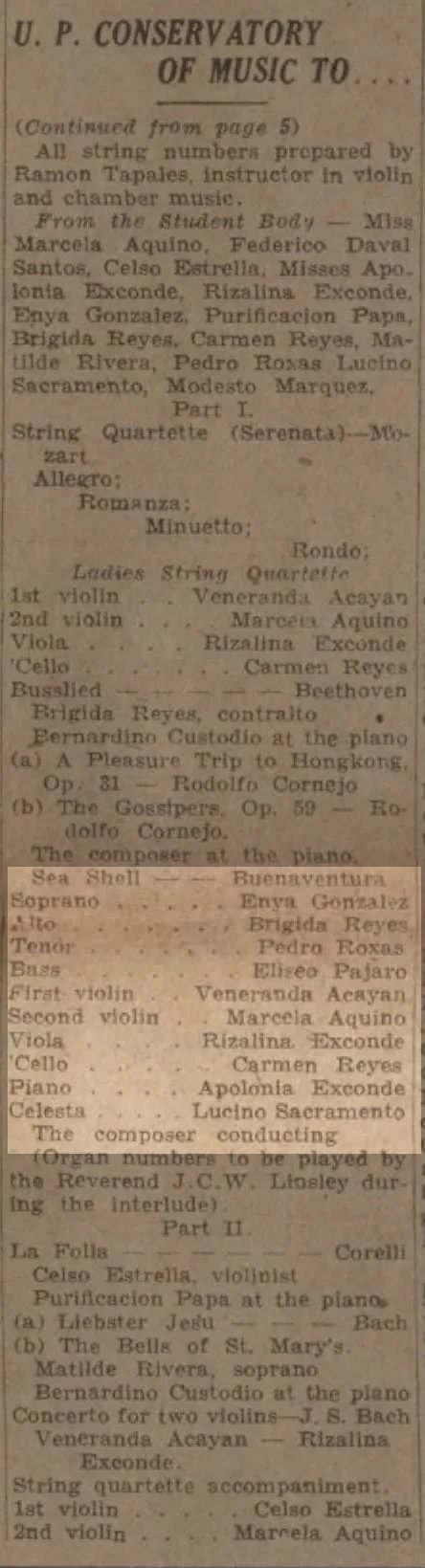
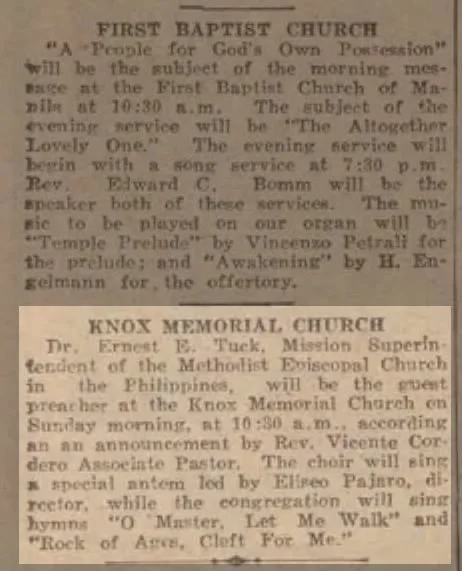
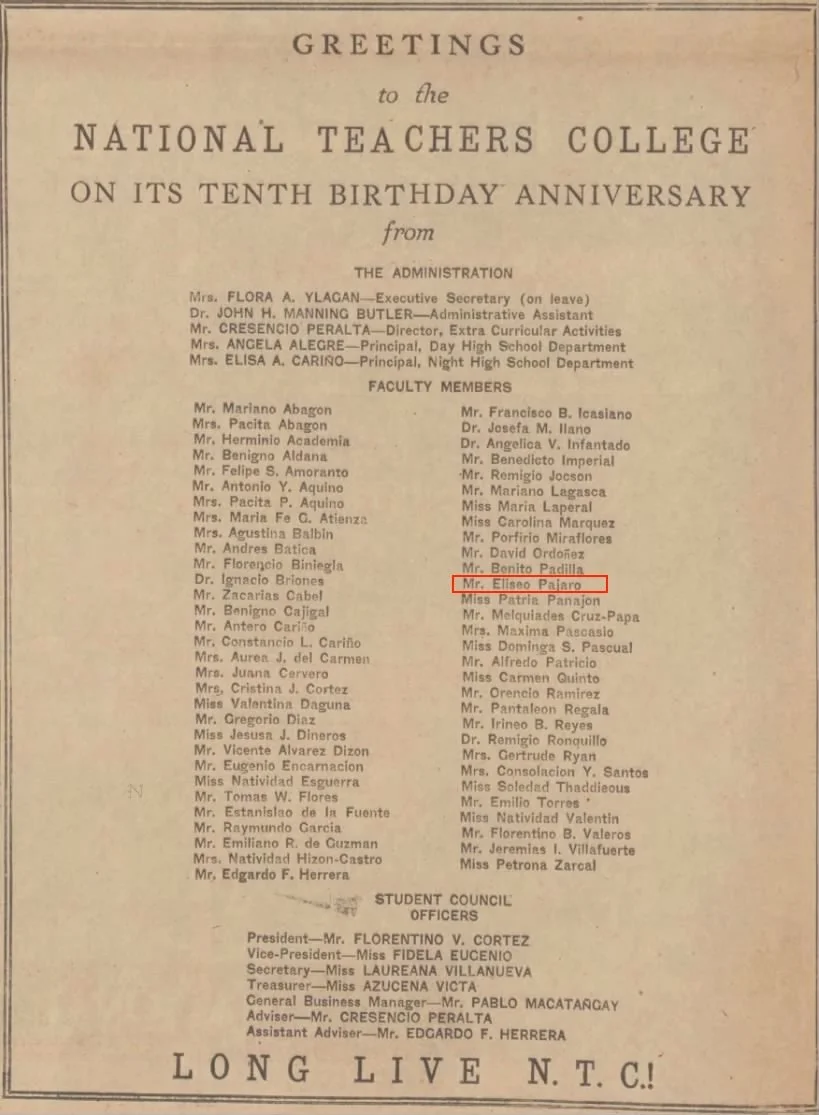
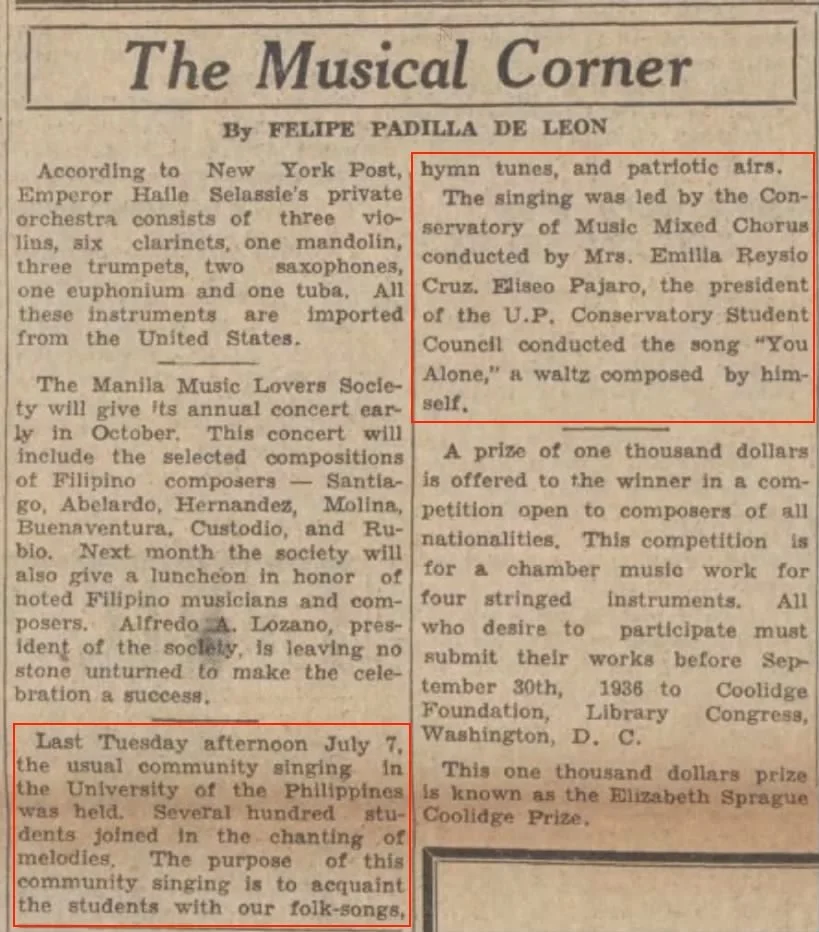
Newspaper clippings from Manila’s The Tribune showed Pajaro’s endeavors turn towards choral music—singing, conducting, and teaching it—while at the UP Conservatory. He sang bass in and conducted the conservatory choir, leading events that taught Filipino folk songs to the public as well as introducing Filipino classical music to new audiences, an endeavor that potentially previewed his career down the line. Pajaro was also a devout Christian and thus served as music director at the Knox Memorial Church, who later helped him secure a scholarship to study in the United States. Starting in 1939, he was teaching music methods and choir at the National Teacher’s College while simultaneously attending to his studies, proving to be fruitful for his teaching duties at Eastman and later professorship at the UP Conservatory.
Citations from left to right:
The Tribune, Manila, Philippines, November 11, 1933, newspapers.com.
The Tribune, Manila, Philippines, November 28, 1937, newspapers.com.
The Tribune, Manila, Philippines, September 29, 1939, newspapers.com.
The Tribune, Manila, Philippines, July 16, 1936, newspapers.com.
