Introduction
It’s April 1952. The Eastman-Rochester Symphony Orchestra, conducted by the school’s music director Howard Hanson, is gearing up for a marathon concert of student composers’ orchestral works. On the program are two new concertos for cello and bassoon, an elegy for strings, a concert overture, and—the Philippine Symphony by Eliseo Pajaro. The piece begins with a soft, mysterious cello and bass soli–the “dark” strings colors as his professor Bernard Rogers puts it. B-flat seems like the tonal center, but it’s difficult to parse out a mode. Our sense of time is also off-kilter, given the irregular 5/4 meter. Perhaps Pajaro was inspired by the “limping waltz” in Tchaikovsky’s “Pathetique” Symphony. Or maybe Pajaro wanted the listener to feel “lost,” as if we’re wandering in the dark and can’t quite find our sense of direction. Measure 9 puts us back in our place, for the whole orchestra joins forces and asserts the opening melody at a forte dynamic. Our sense of unity is maintained until the music climaxes at measure 24, after which the winds change direction with lyrical melody. The piece takes many twists and turns, but one thing is certain–Pajaro strives for extreme contrasts in harmony and orchestration.
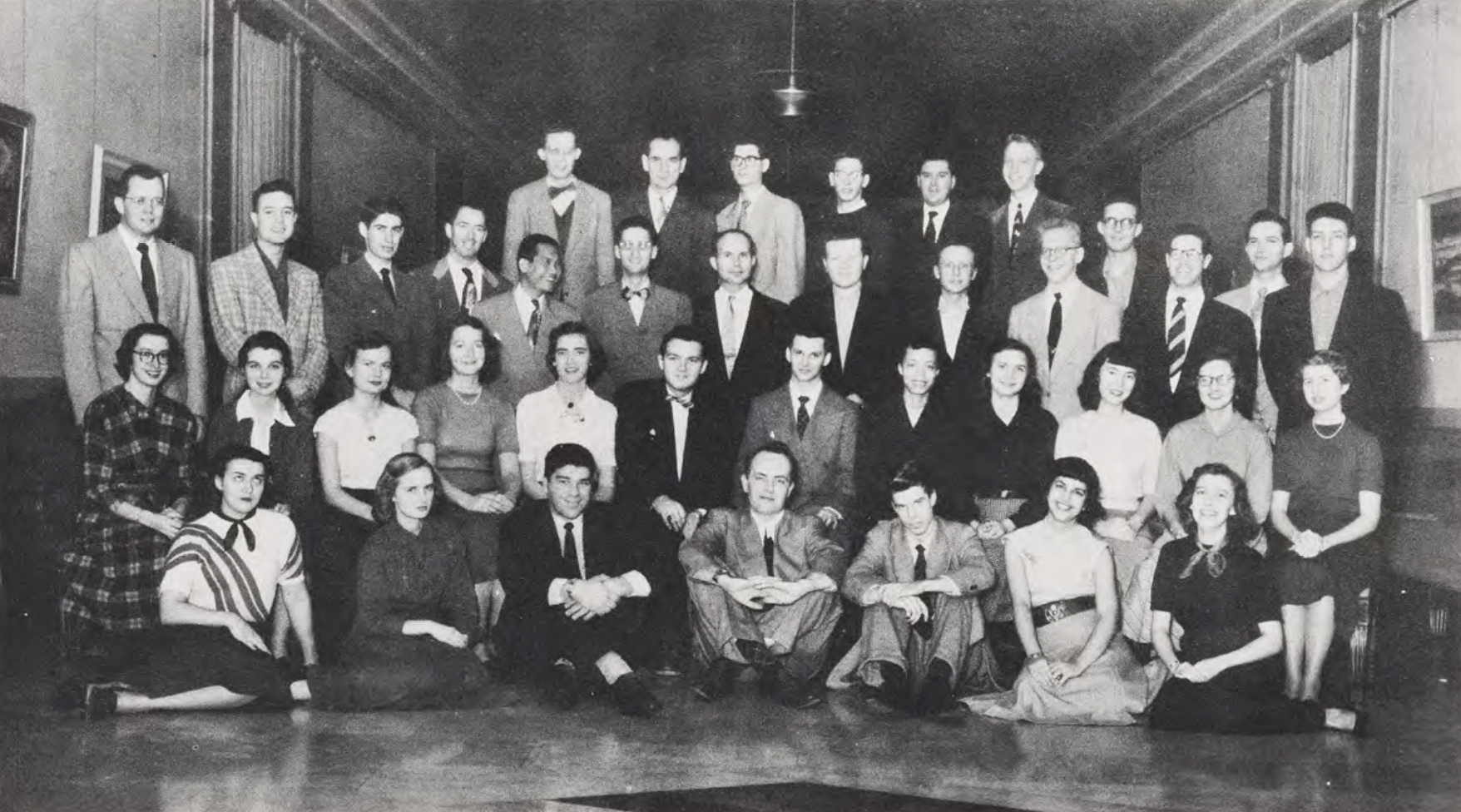
Eastman Graduate Class of 1953. Pajaro: second row from the top, fifth from the left. Source: University of Rochester Digital Collections
That year, Pajaro was finishing his PhD in composition at the Eastman School of Music, with this very symphony serving as his dissertation. He was set to graduate in January 1953 and return to the Philippines soon after, becoming one of the first Filipinos to graduate from Eastman. He then spent the rest of his career teaching music theory and composition at the University of the Philippines Conservatory of Music and conducting the Philippine National Symphony Orchestra while advocating for the study and creation of “serious music” in the Philippines. In 1955, he, along with ten other counterparts, founded the League of Philippine Composers and the Philippine Music Educators Group. The goal of the League was to write major works in Western forms like the symphony or opera while incorporating Filipino folk songs and instruments, whereas the Music Educators Group strived to “Filipinize teaching materials” through the incorporation of folk songs and dance in the public schools. He even won the prestigious Guggenheim Fellowship in 1959 to compose his opera Binhi ng Kalayaan, which told the story of the Filipino nationalist José Rizal. To Pajaro, the role of a composer in the post-colonial Philippines was a serious matter. For one, the composer, through the writing of “quality” music in Western forms, contributed to the image of the Philippines as an advanced, forward-thinking society. On the other hand, Filipinos were grappling with their cultural identity after three centuries of Western colonization. The promotion of Filipino artistic practices, both on the stage and in the classrooms, was vital for national consciousness and pride.
Despite Pajaro’s impact on Filipino arts and culture, his musical legacy at Eastman and the United States at large is largely forgotten today. Using archival documents found in the Eastman Special Collections, as well as digitized newspapers from the United States and the Philippines, I construct a narrative of Pajaro’s early career as a means to circumvent institutional amnesia. Concert programs, original score manuscripts, and historicized newspapers point towards a two-way exchange between Pajaro and Eastman; although he was here to study composition and orchestration with Howard Hanson, Bernard Rogers, and Wayne Barlow, he was also here to introduce Americans to Filipino music and culture. I argue that Pajaro began to fulfill his proclaimed role as a composer in the “New Society” at Eastman, well before the height of his career.
I first provide a brief history of the American-colonial and post-colonial Philippines to better understand the place of Western arts and education in the early 20th century. I then explore how the synthesis of Western and Filipino art music served as a means towards developing a national identity and how Pajaro’s early career—from before Eastman to his doctoral graduation—aided in those developments. I then hone in on the first movement of the Philippine Symphony by analyzing the interconnections of form, harmony and orchestration. Following music theorist Roger Grant, I believe music analysis “can help us to reimagine the social relationships, routines, and power dynamics that animated [Filipino orchestral music].” Specifically, analysis within this context serves three purposes: 1.) to the compositional language Pajaro was working with at that time; 2.) to help empathize with Pajaro and other 20th-century Filipino composers who valued prowess in Western music traditions as a way to attain higher social and/or economic status; 3.) to view the orchestra and its corresponding genres as symbolic of cultural identity. To my knowledge, there are no publicly-available recordings of the piece. Therefore, I construct MIDI recordings using digital notation software and digital audio workstation Logic to aid my analyses. Pajaro’s original manuscript served as my guide throughout the transcription process, and I do my best to remain faithful to the score.
There is one glaring omission from my analysis: the Filipino elements used in this symphony. In an interview with Pajaro, Howard Hanson asks him to explain the Filipino folk songs in the Philippine Symphony. However, the interview transcript, found in the Special Collections, only contains Hanson’s part. Likely, this document was Hanson’s script, for this interview was being recorded for a radio broadcast. Despite my best efforts, I have been unable to identify which folk songs were used in his symphony. There is no secondary literature on the piece, and I have been unable to find any semblance of program notes in the archives. This is an area of further research I would like to pursue, and I would appreciate any leads. However, the lack of primary or secondary surrounding this work only exemplifies said institutional amnesia. It is my hope that this project sparks further discussion of Eliseo Pajaro’s music and his legacy.
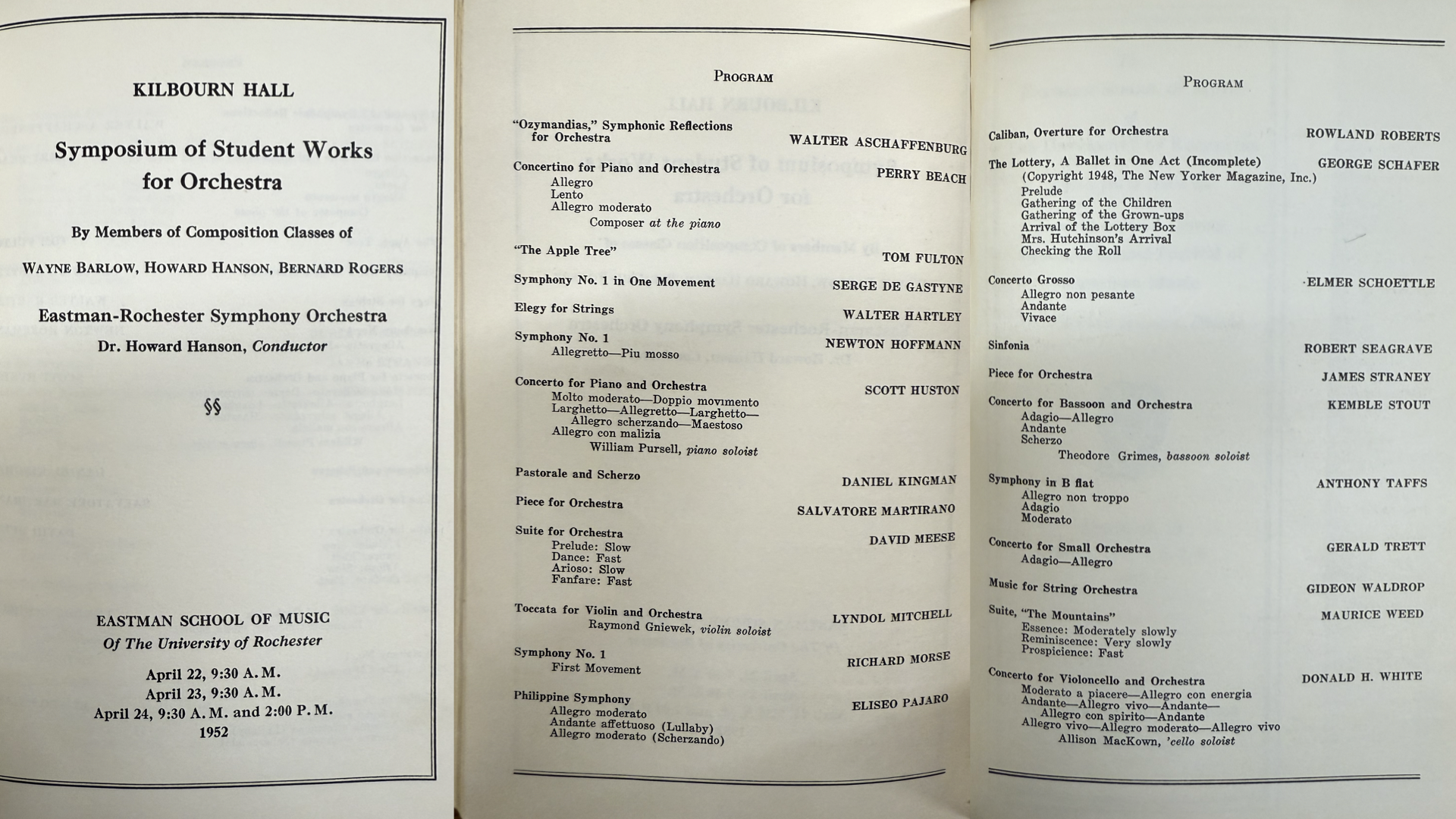
April 1952 “Symposium of Student Works” program. Source: Sibley Music Library Special Collections
